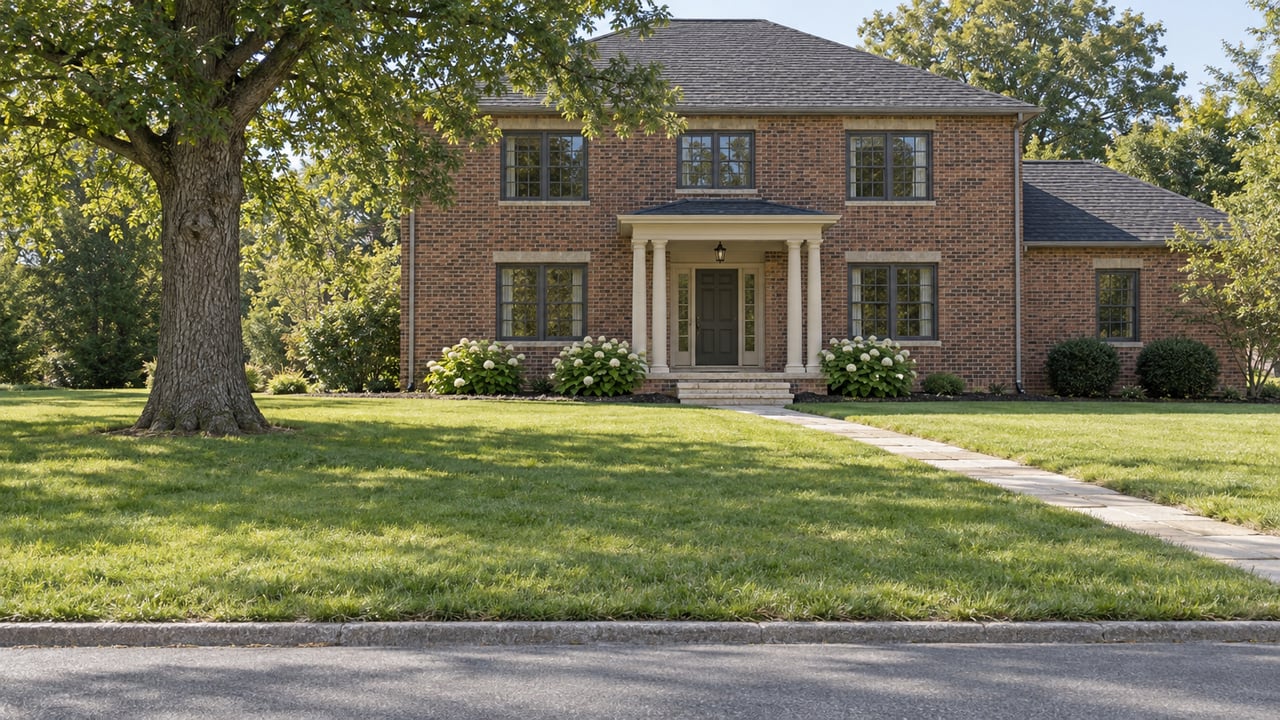
The Number Everyone Quotes for Frontenac Home Prices Isn't the One That Matters
October 1, 2026
October 1, 2026
Check three different real estate data sites for Frontenac, Missouri in the same season and you'll get three different medians that don't agree with each other by hundreds of thousands of dollars. Redfin put the median sale price at $1.7 million in March 2026, up 89.4 percent year over year. Movoto had it at $1 million in July 2026, based on nine closed sales. Zillow's home value index, which measures typical value across the whole housing stock rather than a raw sales median, showed an average of $1,293,532 as of July 31, 2026.
None of these sites are wrong. They're measuring different things in a market too small to hold still long enough for any single number to describe it. The story worth understanding if you're comparing Frontenac to Ladue, Clayton, Town and Country, or Des Peres isn't which of those medians to trust. It's why the number moves so much in the first place, and what has stayed fixed underneath it since before any of these homes sold.
Movoto's July 2026 snapshot is the clearest window into why Frontenac's pricing data behaves the way it does. Nine homes sold that month, down from 14 in July 2025. Average time on market stretched to 41 days, compared to just 9 days the year before. That's a market moving at a fundamentally slower pace than it was twelve months earlier, and it's happening across a pool small enough that a single high-end sale or a single smaller villa closing can swing the median by six figures without any real shift in what typical Frontenac homes are worth.
Redfin's per-square-foot figure tells a similar story from a different angle. Median sale price per square foot in Frontenac hit $366 as of March 2026, up 35.1 percent year over year, a jump steep enough to suggest the mix of homes selling that month skewed toward larger, more expensive properties rather than a uniform citywide price increase.
None of this means the data is broken. It means a monthly median calculated from nine transactions carries a much wider margin of error than the same statistic calculated from the hundreds of monthly sales you'd see in a larger suburb like Chesterfield. Nine sales is not a large enough sample to smooth out one unusual transaction. In a market that thin, a single $3 million estate sale or a single $650,000 villa closing can move the number more than an entire quarter of normal market activity would in a bigger city.
While the monthly medians bounce around, one fact about Frontenac hasn't changed in decades and won't change without a formal act of the city's Board of Aldermen. Most residential land inside Frontenac sits in the city's R-1 One-Acre Residence District, which requires a minimum one-acre lot for a single-family home. The next tier down, R-2, still requires a minimum lot size of 7,500 square feet. Frontenac's own zoning code spells this out directly in Chapter 405 of the Municipal Code, and the city's building department confirms the same thresholds on its public FAQ page.
There's a third category worth knowing if you're looking at anything other than a standalone single-family home. The R-3 Villa Residence District, meant for coordinated villa-style developments, requires a minimum of five acres for the overall development, caps density at 3.5 units per acre, and limits any single structure to no more than two attached units. Any request to build outside these thresholds goes through the city's Architectural Review Board, which meets roughly every two weeks at Frontenac City Hall, and ultimately requires sign-off from the Planning and Zoning Commission and the Board of Aldermen.
What this means in practice is that Frontenac has a hard ceiling on how many buildable lots can ever exist inside its boundaries, a ceiling set by ordinance rather than by demand. A hot buying season doesn't create more one-acre parcels. A slow one doesn't remove any either. That structural scarcity is what has kept the long-run price trend climbing even in a year when the monthly sales medians swung wildly in both directions. Walletinvestor's July 2026 pricing model, built on trailing sales data, still projected continued appreciation through 2031, and that forecast leans on the same fixed supply story the zoning code describes rather than on any single month's closing numbers.
Frontenac sits in a corridor of similarly land-constrained, close-in suburbs, alongside Ladue, Clayton, and Town and Country. All of them share a version of the same dynamic: small city footprints, low sales volume in any given month, and zoning that has historically favored larger lots over denser infill. The difference is scale. A city the size of Chesterfield sells enough homes in a typical month that one unusual transaction barely moves the average. Frontenac, with a residential base built almost entirely around one-acre and quarter-acre-plus lots, will likely never sell enough homes in any given month to produce a median that behaves the way a larger suburb's does.
That's not a reason to distrust Frontenac as a market. It's a reason to read the market differently. A single month's headline number tells you less here than it would in a deeper market. A trend across several months, paired with the days-on-market shift, tells you more. The jump from 9 to 41 days between July 2025 and July 2026 is a real signal about how buyers are behaving this year, independent of whatever the median happened to be in any single month along the way.
If you're evaluating a specific Frontenac property against the broader market, the citywide median for that particular month is close to the least useful number available to you. More useful questions include what zoning district the parcel actually sits in, since that tells you what could legally be built on adjacent lots and constrains how the immediate block can change. Whether nearby permits point toward teardown-and-rebuild activity, which tends to concentrate in older sections of R-1 zoning where original homes sit on land now worth more than the structure. And how long comparable homes in the same size band have taken to sell over the last two or three months, rather than relying on a single month's closing price.
None of these questions require guessing at which data platform's median to believe. They come directly from public zoning records and from watching how comparable homes in the same lot-size tier have actually moved.
If you're weighing a specific Frontenac property against what else is on the market this quarter, that conversation is best had lot by lot, not headline by headline. The Julie Moran Team can walk through the real comparables with you and help you read a listing the way the zoning code and the sales data actually support.
October 1, 2026
September 24, 2026
September 17, 2026
September 15, 2026
City, County, or St. Charles? Your Local's Guide to Living in Greater St. Louis

September 10, 2026
September 3, 2026
August 27, 2026
August 20, 2026
August 13, 2026
When selling or buying a home, every single one of your concerns matters. Julie Moran Team's greatest source of pride is listening to their clients. They will guide you in the right direction. They are on your side. Julie Moran Team's greatest wish is that your real estate dreams materialize.
16505 Wild Horse Creek Rd Chesterfield MO 63017